

Ten days in Kansai, Japan

April is cherry blossom season in Japan. Across the country, the Sakura tress bloom profusely, giving rise to spectacular floral displays of pink and white. But while this is undoubtedly a stunning time to visit, this incredible country has so much to offer at all times of the year.
We visited in October and fell completely in love. From the warmth and courtesy of everyone we met, to the fascinating culture and the superb accessibility, it was a wonderful trip.
Our adventure started in Osaka – known as Japan’s foodie capital, it certainly did not disappoint. A trip to the famous Kurumon market was an experience. Housed in Osaka’s largest indoor market hall, it plays host to around 150 shops with a wide array of goods on offer. For the seafood lover, there was a huge choice – spiky sea urchins, octopus’ eggs and some of the largest crab legs I had ever seen. Street vendors were cooking up treats at every corner – Wagyu beef kebabs which cost pence but tasted like heaven, as well as many less easily recognised delicacies.

The atmosphere in Osaka was vibrant and energetic, as demonstrated by the huge street parties at Halloween. Women are generally quite modest in their dress. But this was all put aside for one night with a wild array of costumes on display, as everyone gathered to celebrate in the streets. The atmosphere at the waterside area of Dontonburi was fabulous, crazy but so much fun, with everyone out to enjoy themselves.
Osaka is a large sprawling modern metropolis and nowhere is this more evident than from the top of the Haruka Tower, the city’s tallest building. Standing at 300m tall, it offers a panoramic view of the whole city from floor to ceiling windows. It is truly an impressive sight, especially when viewed at night.

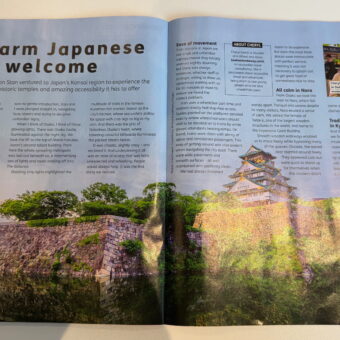
Another sight to visit at night is the spectacular Osaka Castle. Originally built in 1583, it is one of Japan’s most famous landmarks. The castle was periodically renovated between 1931 and 1937 to ensure that it still retained its splendour, especially when illuminated at night.

A short (and easily accessible) train ride away brought us to Nara, which could not have been more different. Visitors flock here to see the famous deer, who will eat from your hand and have learned to bow for treats.

Nara is also home to one of the world’s largest bronze Buddha. It is housed in the Great Buddha Hall, the largest wooden structure in the world. But, despite the many tourists, the city felt much more peaceful and it was great to just wander, enjoying the traditional architecture. As in Osaka, it was easy to get around. Pavements were flat and smooth, buses had lowered ramps and the main attraction had designated routes for wheelchair users, fully ramped to enable easy access.


From Nara, another short train trip brought us to the old capital of Kyoto. This was not as I had expected. In my head I had been imagining a city that felt like the Japan one imagines from many years ago. What we found was another modern city, seen immediately by the incredible railway station that greets visitors on arrival.
But we had been told to look in the spaces and that is exactly what we did. And in those spaces we found the Japan that we had imagined. We saw a geisha going about her business on the tiny street of Pontocho. We savoured the spectacular night-time illuminations at the Kodai-ji temple. In Higashiyama on the eastern side of the city, this stunning temple is a testament to love, built by a widow to honour her beloved husband. The gardens were exquisite. Visitors could see striking vistas and wander through the bamboo groves, illuminated by fairy lights snaking up into the heights. Most of the site was accessible with level paths, although the bamboo grove was accessed by steps.

A night-time visit to the old area of Gion was magical. The city’s most famous geisha district, old teahouses and restaurants inhabit the traditional wooden buildings where geisha still entertain their clients.

But Kyoto was not only beautiful at night! Kinkaku-ji, also known as the Golden Pavilion, is a World Heritage Site and one of the city’s most famous attractions. A Zen temple housed in beautiful grounds, it sits next to a large pond in which the temple is reflected, creating a glorious image. This is highlighted even more when the sun catches it, as the top two floors of the temple are covered entirely in gold leaf.
My personal favourite however was Sanjusangen-do, the Temple of 1001 statues. Pictures are strictly forbidden, which made visiting this Buddhist temple even more intriguing. On entry, visitors go through a few halls before entering the main one, in which 1000 statues line up like a silent army around a large central statue of the goddess Kannon, the goddess of compassion. Every single statue is subtly different. It is said that if you look closely, you will see your own face reflected back at you in one of the many figures.
It was incredible, albeit slightly eerie, with hundreds of these statues ranged in lines, like they were patiently waiting for something, maybe to come alive… This was further enhanced by the monks chanting to them as we left at closing time….
Japan was an experience, unlike anywhere else I have ever visited. An intriguing fusion of new and old, vibrant and energetic, yet with a definite underpinning of the traditional. Neon lights and colourful signs advertised every kind of entertainment and shopping experience, while mingling with the crowds on the streets would be young women dressed in traditional kimono.
Everywhere we went, we experienced the most phenomenal hospitality. Whether that was the young woman, who spoke no English but gave up fifteen minutes of her time to help us navigate a busy train station, or the woman who stopped us on the street to give us an umbrella when it was raining. It is considered rude to eat or drink when walking along the streets or on public transport, but this is reflective of the innate consideration that people here show to those around them. This even extends to signs, reminding people to keep their belongings close to hand in public places. Not, as in Europe, because of theft, with the crime rate being very low here, just to ensure that you are not causing difficulty to anyone else.
From an accessibility point of view this was hugely helpful. We were very impressed by how easy it was to travel by public transport. All the train stations were accessible with plenty of lifts, and at least at the bigger stations, clear signage in English too.
Pavements were generally wide and smooth, in good repair, making getting around straightforward. While there were of course some restrictions to access, due to the architecture of old buildings, we were continually surprised by how much thought had gone into to making as much as possible accessible. And where there were shortcomings, even if they were few, people were always eager to help. I can’t wait to return.
An edited version of this article was originally published in Ability Needs magazine. To view the article please visit https://issuu.com/abilityneeds/docs/ability_needs_spring_q2_2025, pages 44-45.


Related Posts
-
Visiting Japan with Motability Lifestyle
March 27, 2026 -

The North-East Tourism Conference, Aberdeen
January 2, 2025 -
Ability Needs – Dreaming of Italy
August 3, 2024 -

Writer for leading disability magazine
April 11, 2024